
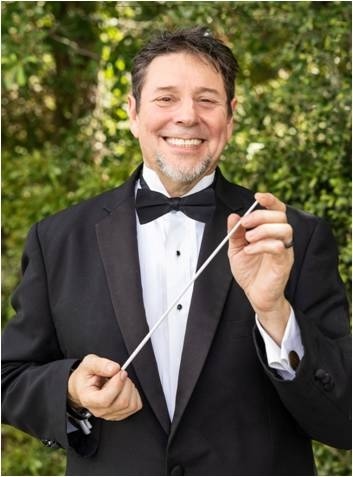
In 2013, five years after The Woodlands Symphony Orchestra folded, trumpeter Darryl Bayer led the effort to revive the performing arts nonprofit. Since then, the orchestra has performed countless concerts, including shows at The Cynthia Woods Mitchell Pavilion and for The Woodlands Township Arts in the Park program.
Bayer, who is a Young Texas Artists Music Competition alumnus, recently told YTA about The Woodlands Symphony Orchestra’s journey and shared his insights on launching a career in classical music.
How did The Woodlands Symphony Orchestra get its start?
There was a Woodlands Community Orchestra in the ’80s, and that turned into the Woodlands Symphony Orchestra. I was the principal trumpet from the very inception of that until 2008.
During 2008, there was a financial crisis going on, and the symphony had to close. Over a course of about five years, people kept on nudging me. “Darryl, start The Woodlands Symphony back up.” I was not really interested at first, but after enough nudging and poking — I think I had a few bruised ribs along the way — I got a small board together.
Our first thing to do was raise awareness that the symphony was coming back, so we arranged a concert with The Woodlands Township Parks and Recreation at Rob Fleming Park. I had some friends in Houston that had a cover band, and we decided we would do The Beatles with the symphony orchestra because the second side of Abbey Road is very orchestral. We did a free concert called Come Together, and we formed a grassroots movement to bring awareness to the Woodlands that, yes, you do have a symphony. That was 2013. We’ve been going and growing ever since.
What excites you about The Woodlands Symphony Orchestra today?
What really excites me is getting to curate each concert. We’ve done so many concerts. We did one called Guitar Heroes. There’s a very famous video game called Guitar Hero, and we opened with music that was heroic. We did Beethoven’s heroic symphony, Beethoven’s “Heroic Symphony,” and a piece by John Williams called “Summon the Heroes.” We did a Vivaldi guitar concerto also. Then in the second half, we played music of Carlos Santana.
Every year we present crossover concerts that combine classical and popular music. That’s become our branding.
(The symphony’s next concert, “Swing and Singing with the Symphony,” takes place Dec. 20, 2026. Click here for updates.)
What are some lessons you’ve learned since you brought the orchestra back to life?
People skills: to work with the musicians, understand everybody’s feelings and have relationships with the other musicians. When you’re the director of the orchestra, and you have 60 musicians, they’re all different personalities with different needs.
What are some of your long-term goals for the orchestra?
One of the long-term goals is that we grow the season. We’ve grown from three concerts a year to four, and the next step would be to grow to five concerts.
Can you tell us about yourself and what drew you to a career in classical music?
I was an experiment for my Uncle Irving, who was a music teacher in Boston. He gave me a cornet when I was 6 years old, and he started giving me private lessons. When I was 13, 14, and 15, I was winning solo competitions with the Boston Symphony and the Boston Pops. At the same time, my friends were all in garage bands and rock bands, and I was playing rock on the keyboard and synthesizer. And I will tell you, there were some people who were worried about me: “What’s Darryl going to do?”
Today, I bring those experiences from my youth — of being raised classical but also having this love to perform as a rock star — to like-minded people in The Woodlands Symphony.
What are some of the challenges that classical musicians face in the early stages of their careers? What advice would you offer them?
Longevity. I’m not talking about in age, I’m talking about in career, in sticking it out. You’re going to have ups and downs.
The thing for musicians is you’ve got to have a sense of being a businessperson. Music isn’t just playing music. Music is the business of music and understanding how to market yourself and network.
I think the only thing that I would like to add is in life, not just music, have a good balance. Appreciate other things. I love going to the gym and eating healthy. I love wildlife and trying to bring the deer back to this region and trying to bring the wood ducks back to our little pond. And if you’re not reading the Bible every day and making sure that you’re having a relationship with God, you’ve got to have that.
I’m going to pick an odd instrument as an example: the bassoon. You may think, I play the bassoon; I’m a bassoonist. No, that’s what you do for your job. It’s who you are as a person that really makes you.