
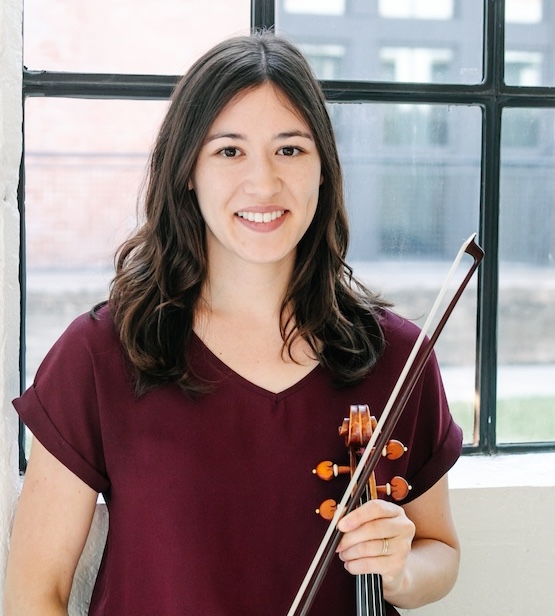
Violist Tonya Burton is the program director for Monarch Chamber Players, a group dedicated to making high-quality chamber music accessible through free concerts across Texas.
Burton has been a guest artist for the Houston Viola Society, Texas A&M University-Corpus Christi, and Texas Lutheran University, and she has been featured on classical music stations in Portland and Los Angeles. Her solo album featuring the music of composer Max Reger won a 2022 Wammie Music Award (the Wammies celebrate the music of the Washington, D.C., Maryland, and Virginia area) for “Best Classical Song.”
In addition to her role with Monarch Chamber Players, Burton is also a core member of Kinetic, both performing and programming for the Houston-based ensemble known for showcasing diverse, underrepresented, and newly composed classical music. She is a founding member of Arco Strings and the Washington, D.C.-based Natonya Duo.
Burton recently spoke with us about Monarch Chamber Players and shared insights for emerging classical musicians.
Please tell us how Monarch Chamber Players got its start.
Monarch Chamber Players got started during the pandemic in October of 2020. Everything was shut down, and there was no work. I wasn’t living here at the time, but the founder, Rebecca Tobin, and a lot of other Rice University graduates just wanted to play music. So Rebecca and our other founding members, like Doug DeVries, started playing on porches and in park concerts for the community. And they turned out to be like major hits.
That’s how it started: playing chamber music for the community, outdoors in these safe settings, doing fun arrangements and being highly creative. Even when the pandemic ended, the musicians loved having that creative outlet. They filed for nonprofit status and started expanding the instrumentation to what it is today, which has strings, winds, percussion, and harp.
What do you want people who are unfamiliar with Monarch Chamber Players to know about the organization?
That’s a tough question because there’s so much to say. There are so many facets to what we do, like the porch concerts and these outdoor park concerts for the community. These are staples of our organization. But we also do more formal indoor concerts at churches and concert venues.
The thread running through each of these concerts is that we want the music to be super engaging, accessible, and kind of surprising. A common thing we hear after concerts is how much we surprised people: how much they loved the pairings with new music or pop arrangements. We often play lesser-known works. And each concert is a different configuration of instruments. Sometimes it will be oboe, cello, and harp or flute, viola, and harp — something that is unexpected.
I should also mention that all of our concerts are free. During our main stage concerts, we sometimes suggest a donation, but everyone is always welcome.
It sounds like you’ve made it a priority to make classical music accessible. Why has that been important to the organization?
On a core level, we believe in the power of connecting with people through music. So the venues we choose are important to us. We choose places where people can get there comfortably. They’re very friendly settings. And, of course, making sure everyone can come, regardless of money, is important to us.
The other facet of this is making the music feel very accessible to people. So we often will talk through our concerts and provide a bit of background on the music, why it’s important to us, or how it affects us. I think that impacts the listeners’ experience.
And even the way that we program, we’re always thinking about the audience and what it would feel like if you’re hearing it for the first time. Even when it’s something standard for us. Of course, we know Beethoven’s Septet; it’s a famous piece. But for someone who’s never heard it, how would it feel if it were paired with jazz?
We’re always making things a little bit different and more approachable in a unique, fun way.
There have been so many great concerts. I remember playing a holiday show. It was a porch concert, and it was flute, harp, and viola. There were tons of kids at this concert, and they were so fascinated with the harp. And our harpist, Hope Cowan, is amazing. Thankfully, she had her backup harp. She basically did an instrument petting zoo for these kids. I have pictures of five different kids’ hands strumming her harp. That’s a strong image in my mind because it’s representative of the group. We love to share music, and the education element is so strong.
What have been some of your most memorable experiences with the group so far?
Also, one of the programs we played a few months ago was curated by Doug DeVries and our bassist, Dave Connor. Dave did all these crazy arrangements. There was a Gershwin prelude that he arranged originally for piano, but then it was for bass, violin, and viola. And he was doing percussion on his bass at the same time. He also arranged a piece that was originally a harp part that he did on the bass. I like that memory because it showcases the creativity and the artistry of our individual musicians.
Is there something you’re particularly proud of or excited about when it comes to the group?
I feel very proud of everyone, both individually and collectively. In the next few years, it feels like there’s so much room and possibility for even more creativity. We have a lot of good momentum. We’re still quite young, but it feels like we’ve laid down a lot of important roots in Houston. I’m excited to see where things go.
Tell us a little bit about yourself. What drew you to a career in classical music?
I started on piano when I was 5, and then I started playing viola in elementary school strings class. But it was really in high school that I decided to pursue music (as a career). Every time I hear music, it affects me in some way, and I always feel emotionally very connected to what I’m hearing. I remember, after my sophomore year of high school, I went to a chamber music camp. And the Arianna String Quartet was playing Janáček’s “Intimate Letters,” Janáček’s String Quartet No. 2. That was my first time hearing a live string quartet, and it was so impactful to me. I remember feeling like I had to do that. I had to create what had been given to me.
Why do you think that classical music remains relevant?
As long as people have emotions, classical music will always be relevant.
Whenever we talk about classical music, it’s very separate: there are all these different genres. But everything is connected, and every piece of music affects us differently. And with certain pieces, certain styles of classical music, it’s inexplicable. Why does this Bach cantata make you feel the way you do?
Would you like to share any highlights of your musical career?
Recently, I’ve been reflecting on my recordings. I had my first solo CD in 2021. That was a big highlight of my career. I had gotten a grant from the University of Maryland, where I was working on my doctorate, to do this album.
And then joining the Recording Academy: being able to vote for Grammys is a big deal.
Another group that I’m a part of is called Kinetic Ensemble. It’s a conductorless string orchestra. We released our debut album about two years ago. It was No. 1 on the Billboard Classical chart, which is exciting.
And, recently, I got to perform in Paris for the International Viola Congress. I presented a program with all new music for the viola, most of it written by friends. So that was special.
Another big one was I got the Support for Artists and Creative Individuals (grant) from HAA (Houston Arts Alliance) to commission this beautiful piece written by Nicky Sohn. The music was written in honor of my aunt, who had passed away from metastatic breast cancer. We are expanding that work for string orchestra, and we’ll be playing that with Kinetic in the fall.
From what you’ve experienced and observed, what would you say are some of the big challenges that classical musicians face, especially when they’re starting their careers?
I teach at Sam Houston State University, and so I feel like I’m in tune with a lot of the challenges now. There’s a feeling that every single moment or every single performance is a defining moment, and there’s pressure to prove yourself, especially with all the social media and so much content online.
There’s a lot of anxiety, that feeling that there will not be space for me as an artist.
Another issue I see is that there’s a lot of pressure to define yourself as an artist too soon. Most people put on blinders and choose one path. As an artist, you always have to be a little bit uncomfortable. Sometimes we get so comfortable in saying this is what I’m going to do, and this is how I’m going to do it, and then it doesn’t go that way.
I often tell my students that professional life is about exploration, and the more that you can lean into your curiosities and spend time in the discomfort, even when you’re unsure of what this will look like professionally, the more skills that you gain. The more room you give yourself to experiment, the better.
What other advice would you offer emerging classical musicians?
The reality is your artistry is always going to evolve, and it’s never too late to go into a new rabbit hole. I’ve experienced that with some of my own creative projects. I do a little bit of composing now, and I work with dancers quite a bit. I never would have thought I would be doing this: saying yes to things and being OK with being a beginner in certain spaces. It’s never too late.