
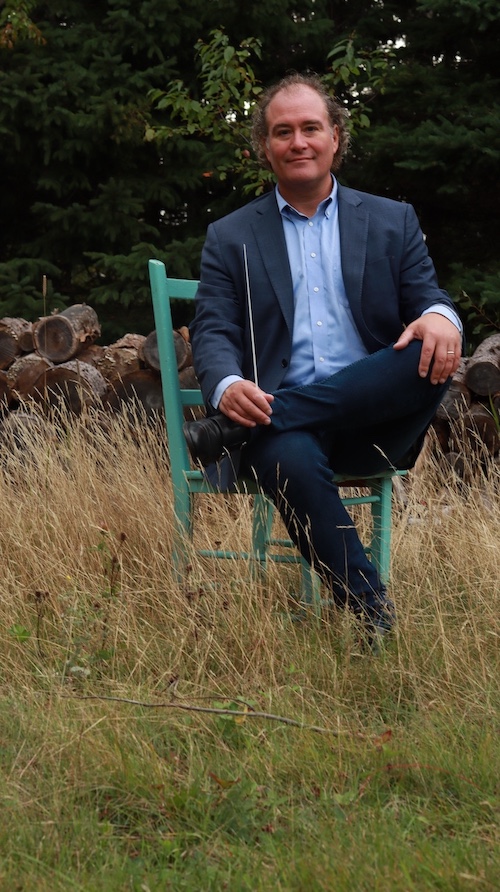
Antoine Plante serves as artistic director and co-founder of Houston’s Mercury Chamber Orchestra, now in its 25th anniversary season. Over the years, he has overseen the ensemble’s growth from a Baroque-focused group to a versatile chamber orchestra recognized for its inventive programming and community engagement.
Earlier this year, Plante agreed to tell us about his journey with Mercury Chamber Orchestra and share advice for emerging classical musicians.
Could you please share the story of how you co-founded Mercury Chamber Orchestra?
I grew up in Montreal, in the province of Quebec, and I went to do a master’s degree at Rice University. At that time I was a double bass player, and I chose the school because of the quality of the education there.
I grew up in a family of musicians, of art entrepreneurs as well. My dad was a director of an early music orchestra in Montreal.
These two things came together. When I was done with my masters, I started experimenting with entrepreneurship ideas, and one of these things was the early music side, the baroque orchestra side, of my upbringing. It was a movement that was very active in the classical music world at that time. We’re talking about the 2000s when CDs were still a big part of the industry, and people were re-recording Bach and Handel and discovering Rameau — with period instruments and techniques.
So I started doing concerts, and it picked up pretty rapidly with the support of both people wanting to help with the administrative part of it, but also with the support of the audience. We moved from church fellowship halls to Zilkha Hall (The Hobby Center), which had just opened. A few years after that, we moved to the Cullen Theater at Wortham Center, where the house was a better size for us.
We still perform on period instruments, but we really do more than baroque. Now we’re a chamber orchestra that performs music from all the periods.
When you look at the last 25 years, what are some of the things that excite you about this orchestra?
One of the things is the repertoire. We’re able to bring audiences the music of Mozart, of Beethoven, at a high level using period instruments. There are a lot of wonderful hours in the rehearsal hall and on stage performing some of the most beautiful things ever created. So that’s something that is valuable.
Another thing on the repertoire side is that because of the way that we are set up, we have lots of freedom artistically to take risks. And so we have a series of multimedia programs where we often merge dance. We stage chamber operas that we create ourselves using the music of existing composers or new music. A lot of creativity comes in on that side, things like a show we did called, “Loving Clara Schumann,” which was telling the story of Clara Schumann, the wife of Robert Schumann, who was a wonderful composer as well. It told their love story and their relationship with Johannes Brahms — all using Lieder (19th-century German songs for voice and piano) that these three composers had composed. So we created an opera that they didn’t write using their music. I’m excited that we’re able to do that.
There are two other sides. One of them is the musician side. I’m proud that we’re able to give a lot of work to wonderful artists in Houston. We have a good amount of quality freelancers here because of companies like Mercury that give high-quality work to these artists, and that creates a strong community in Houston.
Lastly, I’m proud that we are here bringing classical music, bringing the beauty of the world, to the people of Houston week in and out by doing concerts, by going in schools, by having all sorts of different activities to make life better. It’s been an exciting 25 years, and there’s lots to come in the future, too.
What are your goals from here?
They are not necessarily the sexier thing right now because we’re at a point where we’re well established, and one of the harder things to do is to make sure that we are here to stay, that we are resilient. What happens if another pandemic hits? Are we going to still be alive after that? What would happen with another Hurricane Harvey or with a big change of staff? Those are real threats.
And so one of the goals is to create more resilience with the organization, and we’re working with community stakeholders to do that.
The other is just to do what we do more, to reach more people. We want to reach deeper in the community with our neighborhood series expansion and to have our education program expanded as well so that we are in more schools.
Another goal would be to circle back to the musicians. It’s my heart to keep giving great opportunities to musicians. An example of that is our Juilliard Fellowship. It’s a collaboration with The Juilliard School (Juilliard Historical Performance program). After students complete their master’s degree in period instruments, we offer them a fellowship when they perform with our orchestra for a year or two. It gives them a chance to step out into the professional world. These programs are exciting, and they are the type of thing that I want to keep expanding.
It sounds like education and outreach have been big priorities for the orchestra.
Well, this is what we are here for. It’s a role that we have: to bring the beauty of classical music to people’s hearts. I wouldn’t say that education and community are more important than our main performances downtown. It needs to be balanced. It’s important for me that we don’t just touch the people who would naturally go to a concert of classical music downtown, that we also help a less likely audience discover one of the greatest things that humans did.
What are some of the lessons that you’ve learned from the experience of creating this orchestra and the role that you’ve had with it over the years?
In the corporate world or in most aspects of the world, you have a boss. The boss tells you what to do, and you do it. You can’t question it. But you do in classical music because it’s about creating joy a lot of times. Sometimes it’s about other emotions, but, still, a lot of it needs to be done with that in mind. And so the role of the leader becomes much more of a collaborator. If I think of how I was seeing leadership or what mindset I was in before rehearsals 25 years ago and today, I think it’s quite different because I’m putting myself in a posture of listening.
Let’s talk about classical musicians who are just getting started. What would you say are some of the challenges facing these emerging musicians?
One that is really obvious is audience building. You need to find a way to get people to listen to what you do. Symphonic orchestras are good at that, and they work hard at that. But it’s still not a thriving world. There are orchestras in the States that are closing. There is no crisis right now where orchestras are closing right and left; people go to classical music concerts. But the challenge of the future is going to be keeping that going. The world is changing. The techniques that the orchestras have gotten so good at are maybe not working as well anymore. It’s not a big ad in the Houston Chronicle that will make it anymore. You have to, perhaps, have influencers talking about you. And so a lot of those young musicians will have to learn how to find an audience in the world in which they play.
What other advice would you offer to people who are getting started in classical music?
It’s cheesy but try to keep joy in what you do. If we get too serious, it’s not good for anybody. And young classical musicians tend to be really serious.